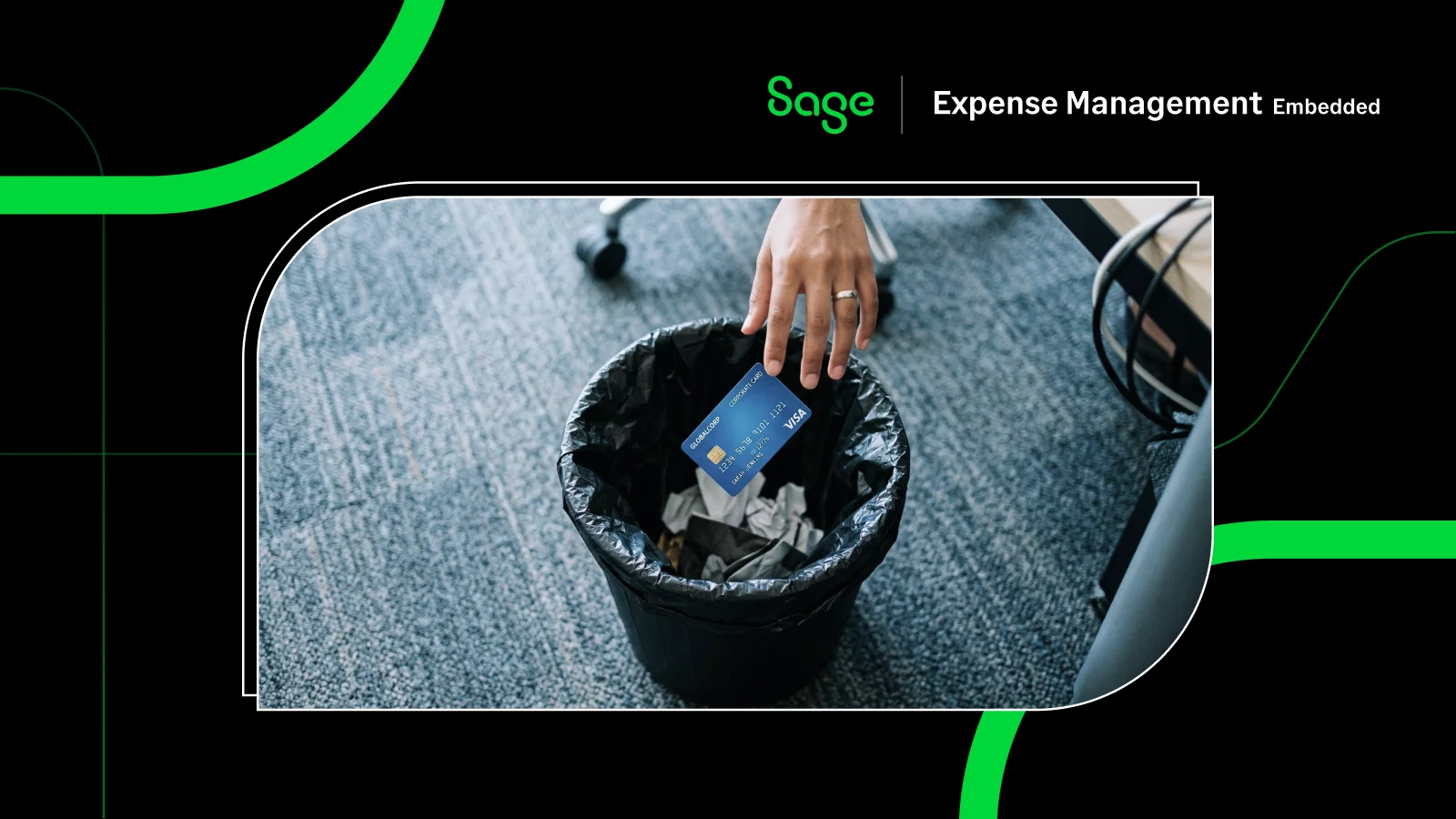

If you are looking at your commercial banking dashboard right now, everything probably looks fine on the surface. Your long-term accounts are still open, and your balances seem stable.
But there is a leading indicator of trouble that often goes unnoticed until it is too late: card spend volume.
At Sage Expense Management, we talk to regional and community bank leaders who are seeing a “silent churn” in their portfolio. A client does not necessarily call to close their account; they just stop using your card. They have moved their daily operational spend to a card from a software company like Ramp or Brex.
They did not do this because they wanted a new bank—they did it because they wanted to stop chasing their employees for crumpled paper receipts.
The Real Reason Fintechs are Winning
The reality is that fintechs are not just selling credit cards; they are selling a way to fix the manual, soul-crushing work of expense management.
Banks and card providers have already lost over $50 billion per year in spend volume to these new-age providers because they offer a unified stack: the card and the software. Most bank-issued cards today are “dull.” They process a payment, and that is where the service ends.
The rest of the work—finding the receipt, figuring out which project the money was for, and getting it into the accounting software—is left to the customer’s exhausted finance team. Once a fintech owns that daily workflow, they become the client’s primary financial interface. They start with the card spend and eventually move after your crown jewel: the operating deposits.
The Friction Your Customers Actually Feel
Consider your most valuable commercial clients—the businesses in construction, energy, or logistics. These workers rarely sit at a desk.
A foreman is usually on a job site or driving a truck, and he physically cannot log into a clunky desktop portal to upload a gas station receipt. That receipt rides on the dashboard for weeks, gets lost, and creates a “reconciliation nightmare” back at the office.
When a fintech card promises to automate that entire headache with a simple text message, the finance team doesn’t just want it—they demand it.
The Vendor Roadmap Trap
Most bank leaders know their technology is stagnant. They rely on massive legacy processors like FIS or Fiserv that control their core infrastructure but move at a glacial pace.
We constantly hear from product VPs who feel “held hostage” by vendor roadmaps that promise a mobile app “next year”—a promise that has been repeated for three years running. Your customers will not wait indefinitely. If you cannot offer them a “smart” card experience now, the “Silent Churn” will only accelerate.
The Data Blindness Problem
Even when clients do manage to submit their expenses, banks often fail them on the data front. Standard bank statements are often “blind” to the details that matter most to a growing business.
A statement might show “Amazon - $5,000,” which is useless for a family office or a construction firm that needs to know exactly which project those materials were for. Without deeper data—line-item details and project codes—the bank card is a liability for the accounting team.
Your Advantage: Relationship Trust
It is easy to feel like you are losing a race against Silicon Valley engineering budgets, but regional banks have an advantage no fintech can code: deep, credit-backed trust.
-
True Credit: Banks offer true credit and personal relationships that help businesses grow through cycles.
-
Collateralized Limits: Most fintechs “lend” based on the cash sitting in a checking account.
-
Relationship Advantage: Clients don’t want to leave their bank; they just want better software around their banking.
Reclaiming Your Turf with Embedded Expense Management
You do not need to spend years and millions of dollars rebuilding your tech stack. The answer is Embedded Expense Management. This allows you to modernize your offering by integrating fintech-grade tools directly into the cards you already issue.
With Sage Expense Management (formerly Fyle), you can turn your existing Visa or Mastercard into a “smart” card:
-
Zero-friction receipt capture: When an employee swipes their card, they get an instant text message.
-
Instant AI coding: They snap a photo of the receipt, and it is matched and coded by AI instantly.
-
Meet them where they are: If a field worker can send a text, they can submit an expense.
-
Speed to market: Launch a fully white-labeled solution in a few months, bypassing legacy processor delays.
By making your card the “path of least resistance,” you ensure it stays at the top of the wallet. This protects your interchange revenue and builds a fortress around your operating deposits.